

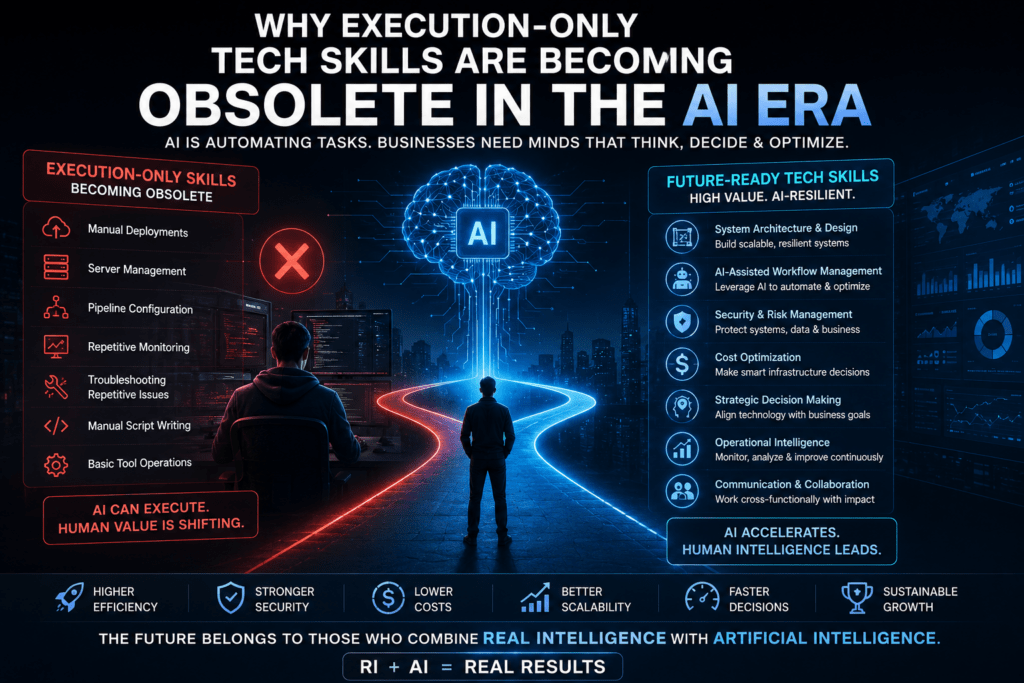
The technology industry is changing faster than ever before.
For years, businesses hired technical professionals mainly for:
- tool management
- deployment setup
- server maintenance
- pipeline configuration
- repetitive execution tasks
But Artificial Intelligence is now transforming how technical operations work inside businesses.
Many tasks that once required hours of manual effort can now be automated, assisted, or optimized using AI-powered systems.
And honestly, this shift is creating a major reality check for the tech industry.
Businesses are no longer looking only for people who can execute tasks.
They are increasingly looking for professionals who can:
- think strategically
- manage systems intelligently
- understand architecture
- optimize costs
- maintain security
- supervise AI-assisted workflows
Because in the AI era, execution alone is no longer enough.
AI Is Automating Technical Execution Faster Than Expected
Modern AI systems are already helping technical teams:
- generate deployment scripts
- automate configurations
- monitor systems
- detect vulnerabilities
- optimize infrastructure
- manage repetitive workflows
Tasks that previously required deep manual involvement are becoming faster and more automated.
This does not mean technical professionals are becoming irrelevant.
But it does mean the role itself is evolving quickly.
Businesses Now Need Decision-Makers Not Just Executors
One of the biggest changes happening right now is that businesses are prioritizing professionals who understand:
- system architecture
- scalability
- operational efficiency
- security risks
- AI workflow management
- infrastructure strategy
Because while AI can generate outputs, businesses still need humans who can decide:
- what should be built
- how systems should scale
- where risks exist
- how operations should remain secure
- what business impact technical decisions create
And those decisions still require human intelligence and experience.
Technical Knowledge Alone Is No Longer the Differentiator
A few years ago, simply knowing how to configure tools or manage deployment pipelines created strong career opportunities.
But now, AI systems can assist with many technical execution tasks within minutes.
This means businesses are shifting attention toward professionals who bring:
- problem-solving ability
- strategic thinking
- business understanding
- operational ownership
- cross-functional communication
- adaptability
Because companies no longer want isolated technical execution.
They want professionals who understand how technology affects the entire business ecosystem.
The Rise of AI-Assisted Operations
Many companies are now building AI-assisted operational environments where:
- automation handles repetitive work
- AI accelerates execution
- human teams supervise systems
- experts focus on architecture and optimization
This shift is helping businesses:
- improve efficiency
- reduce operational delays
- optimize infrastructure costs
- increase scalability
- respond faster to operational challenges
But it also creates a new requirement:
Businesses now need smarter technical leadership, not just more technical execution.
Security and Cost Awareness Are Becoming Critical
As businesses adopt AI-driven workflows, two major concerns are growing rapidly:
- cybersecurity
- operational costs
AI can automate workflows quickly, but poorly managed systems can also create:
- security vulnerabilities
- infrastructure waste
- operational inefficiencies
- compliance risks
This is why businesses are increasingly prioritizing professionals who can balance:
- automation
- security
- scalability
- cost optimization
- operational reliability
Because in modern businesses, technology decisions directly affect financial performance and brand trust.
The Human Side of Technology Still Matters
No matter how advanced AI becomes, businesses still depend on:
- leadership
- judgment
- accountability
- communication
- decision-making
Technology professionals are now expected to work beyond technical execution.
Businesses value professionals who can:
- collaborate with teams
- understand business priorities
- communicate clearly
- adapt quickly to changing systems
- manage AI responsibly
Because businesses are not only building technology.
They are building systems people depend on every day.
Entrepreneurs and Businesses Should Pay Attention to This Shift
Many companies still hire based only on technical execution skills.
But the market is changing rapidly.
The future belongs to businesses that build teams capable of combining:
- technical expertise
- strategic thinking
- operational intelligence
- AI-supported execution
- human oversight
Businesses that adapt early may gain:
- better operational efficiency
- stronger scalability
- improved system reliability
- smarter automation workflows
While businesses that ignore these changes may struggle to maintain long-term operational flexibility.
The Future of Technology Will Depend on RI + AI
At Soshell Digital LLP, we believe the future of technical operations will not be driven by AI alone.
It will belong to businesses that combine:
- automation with oversight
- AI with strategic thinking
- technical systems with human judgment
- operational speed with responsible execution
That is why we believe strongly in RI + AI —
Real Intelligence combined with Artificial Intelligence.
AI can automate technical execution and improve efficiency. But real intelligence ensures that systems remain secure, scalable, practical, and aligned with real business goals.
Because technology alone cannot build sustainable businesses.
Smart human decisions still remain at the center of every successful system.